
Years inside medicine, both at the bedside and in the boardroom, made one thing clear to Dr. Bhatia: The system asks physicians to give continuously, with almost nothing built in to restore them. Physicians are trained to recognize burnout in their patients, but rarely in themselves. She wants to shift that conversation.
In this series, Dr. Bhatia will offer practical, evidence-informed ways to bring balance back into clinical life, drawn from both modern medicine and the older traditions she has studied.
I practiced medicine inside this system myself. And like many physicians, I learned early how normal it was to ignore my own physiology just to keep up with the demands of the day.
There’s a moment many physicians recognize.
It’s the moment when the clinic finally quiets down, the last patient leaves, and you sit in your car in the parking lot. The engine is off. The phone is still buzzing. And suddenly you realize you’re hungry.
Not mildly hungry.
You haven’t eaten all day.
You pause and think:
Did I even drink water today?
Then you start the car and go home to open your laptop and finish charting.
This moment is so common in medicine that most physicians barely notice it anymore. It’s simply the rhythm of the profession.


I remember experiencing this rhythm myself early in my career as a practicing physician. Clinic days moved quickly—patient after patient, decisions layered on decisions. By the end of the day, I would sometimes realize I had gone hours without eating or drinking, moving from exam room to exam room while managing pages, lab results, and documentation in the margins.
At the time, it didn’t feel unusual. It felt like what medicine required. But it also reveals something deeper about how medicine is practiced today.We are practicing in a system that quietly expects physicians to function beyond normal human limits.
And over time, that expectation carries a cost.
The invisible load physicians carry
When physicians talk about burnout, the conversation usually centers on hours worked or administrative burden.
Those matter. But they are only part of the story.
What many doctors are actually experiencing is something less visible: physiological depletion combined with cognitive overload.
Throughout a typical clinical day, physicians operate under constant pressure to maintain attention, make high-stakes decisions, manage emotional conversations, and process enormous volumes of information.
And they often do this while skipping the most basic physiological needs—meals, hydration, even a few minutes to pause.

In research interviews with physicians across specialties, many described a daily rhythm that looks strikingly similar:
Early morning inbox scans before the household wakes
A full day of patients with documentation squeezed into gaps
Lunch replaced by charting
Evenings spent finishing notes or catching up on reading in “pajama time” late at night
One physician described the experience this way:
“Sometimes I only have three minutes. If I can’t find it fast, I move on.”
Medicine has always been demanding. But the modern system compresses clinical care, documentation, digital communication, and information into one continuous stream, leaving very few natural pauses.
And the human brain was never designed for that.
Willpower eventually stops being enough
Physicians are trained to push through. I certainly was.
When the body is consistently under-fueled, sleep-deprived, and cognitively overloaded, the effects start to show up in subtle ways:
Decision fatigue increases.
Attention fragments.
Emotional bandwidth narrows.


The physician may still appear highly competent—because physicians are extraordinarily skilled at functioning under pressure. But the internal experience changes.
Work that once felt purposeful can begin to feel mechanical.
And what once felt sustainable begins to feel like a grind.
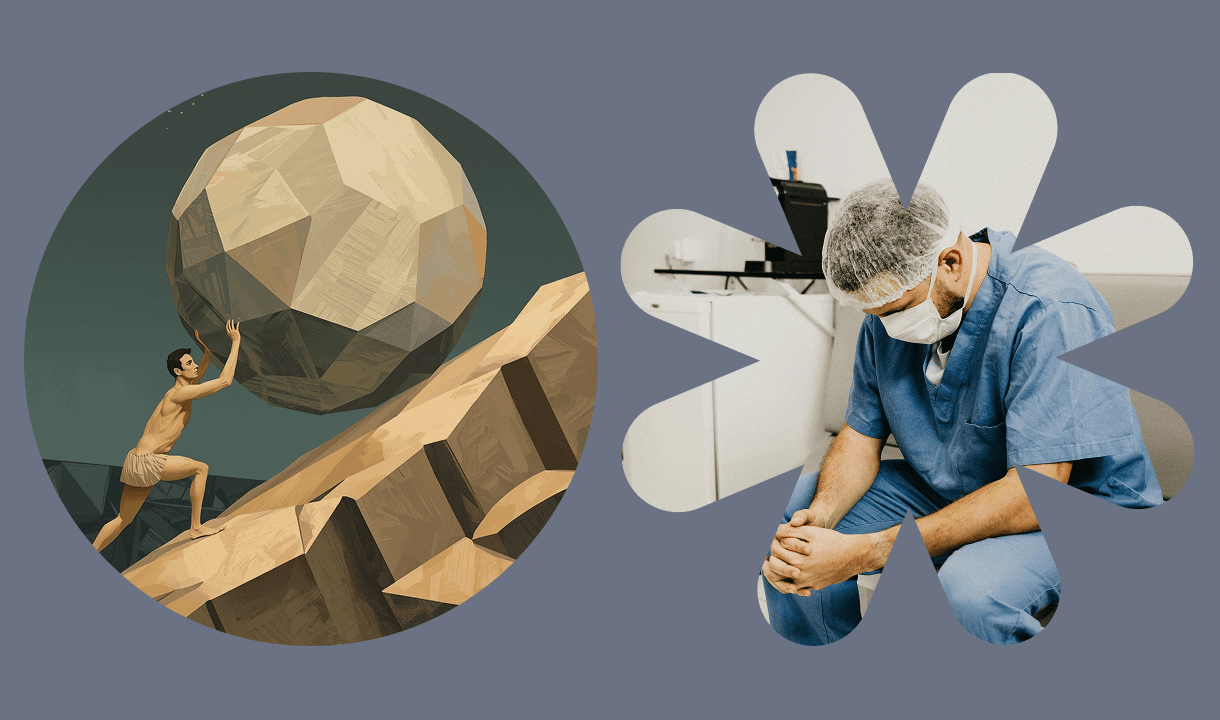
One oncologist in the research described the experience using a metaphor from Greek mythology:
“I refer to myself as Sisyphus—rolling that boulder uphill every night… only to have it roll down again by morning.”
This isn’t about a lack of resilience. It’s the predictable result of practicing medicine inside systems that often optimize for efficiency of output, not sustainability of the physician.
The profession is beginning to acknowledge this
Increasingly, physicians are recognizing this tension.
Across specialties, doctors describe wanting something very simple:
Not less commitment to patients.
But a way to practice medicine that doesn’t require constant depletion.
They want:
Tools that reduce administrative friction
Technology that actually saves time
Information delivered in digestible formats
Systems that recognize physicians as human beings, not just providers
In other words, physicians aren’t asking medicine to become easier.
They are asking it to become more sustainable.
A quiet reframing
One of the most important shifts happening in medicine right now is subtle.
Physicians are beginning to recognize that sustainability is not a luxury.
It is a clinical necessity.
A physician who is physiologically depleted, cognitively overloaded, and emotionally exhausted cannot consistently practice at their highest level—no matter how dedicated they are.
The goal is not to eliminate the demands of medicine.
The goal is to create conditions where physicians can continue practicing with clarity, presence, and purpose over the long arc of their careers. Medicine doesn’t just need skilled doctors. It needs physicians who can sustain the work over a lifetime.
A question worth asking
At the end of a clinical day, many physicians ask themselves:
Did I get through everything?
A more important question might be:
What would it look like to practice medicine in a way that allows physicians to keep showing up — not just today, but for decades to come?
The future of medicine may depend on how seriously we begin to take that question.
Q&A with Dr. Sonal Bhatia:
What are you reading right now? "Wisdom Untethered" by Michael Singer. It is the kind of book I read a few pages at a time and let sit. Quiet, but it does its work.
What new medical trend is exciting you and why? The slow, steady arrival of lifestyle and integrative medicine into mainstream practice. For years, things like breathwork, circadian-aligned eating, and mind-body interventions lived on the margins. Now I am seeing peer-reviewed data, CME programs, and major health systems building these tools into actual care models. It is long overdue, and it gives physicians more ways to genuinely meet patients where they are.
Your one time-saving (or life-saving) tip? Keep your phone outside the bedroom. It sounds small, but it changes the shape of your morning. You wake up to your own thoughts instead of someone else's agenda, and you reclaim that first quiet half hour for yourself.
Your non-negotiable? A morning walk. No podcasts, no music, no listening to anything except what is around me. Just awareness, breath, and whatever the trees and birds are doing that day. My best ideas show up on those walks. The close second is sleep. I am in bed by 9:30 every night and I get a full 7.5 hours. Late nights stopped serving me, so I stopped agreeing to them.